

AppFollow vs. in-house solutions
AppFollow changes how your team handles customer relationships. Stop building custom tools internally and start automating responses with a proven platform. Build better customer connections, reduce development overhead, and grow your app with feedback that truly helps.
85% of teams see faster response times in week one
Teams handle 3x more reviews without hiring more people
$50K saved annually with automation and AI on average
Why teams switch from analytics to action

Works better without being harder
AppFollow gives you customer management tools that work faster, better, and across any audience.
You don't choose between powerful features and ease of use. Smart automation handles routine responses while advanced workflows are a few clicks away.
Features that get results

AI auto-replies
Respond to reviews automatically with personalized, contextual responses

Cross-platform reviews
Handle all app store reviews (and beyond) from one dashboard

Smart analytics
Turn customer feedback into actionable product insights

Team workflows
Role permissions, performance tracking, and collaborative review management
Built for teams, not just analysts
Customer success needs teamwork.
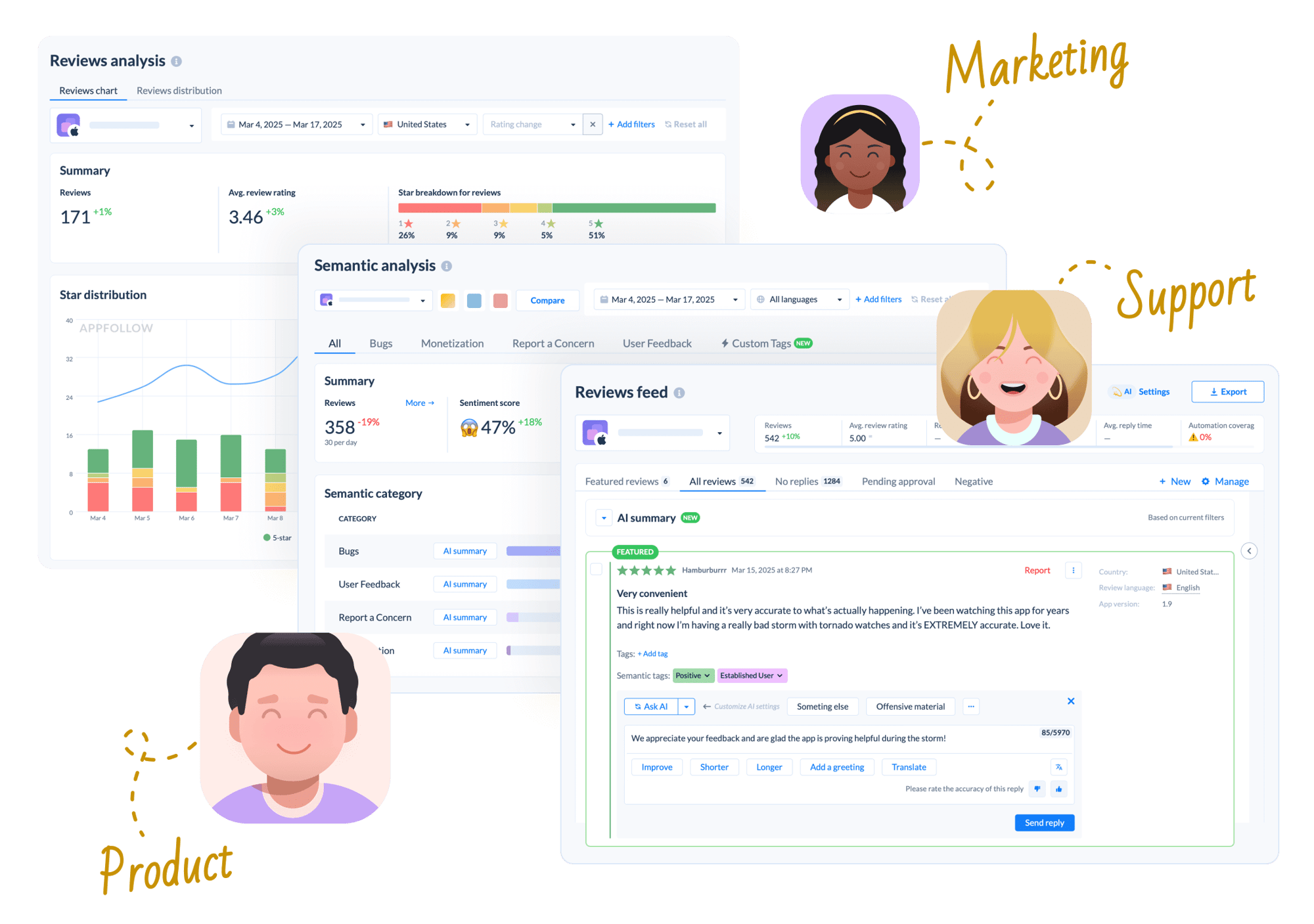
AppFollow has automated tagging, bulk reply actions, team performance dashboards, and workflow integrations that help support, product, and marketing teams work together.
|
Features |
AppFollow |
In-house solutions |
|---|---|---|
| Account pricing & usage | ||
|
Free plan available
Start managing your app reviews with a free plan — no credit card required, no sales call needed
|
✓ No credit card required |
✗ Engineering time required from day one |
|
Predictable cost
Clear, fixed pricing so you know what you're paying each month without unexpected infrastructure or maintenance costs
|
✓ From £99/mo |
✗ Costs tend to grow as scope and maintenance expand |
|
Time to value
How quickly your team can start getting value from the platform after signing up
|
✓ Up and running in minutes |
✗ Weeks to months of build time before anything is usable |
|
Unlimited apps & users
Add as many apps and team members as you need without worrying about per-seat pricing or usage caps
|
✓ Unlimited users on all plans; unlimited owned apps |
Possible Scalability depends on how the system is architected and hosted |
| Review analysis | ||
|
AI summary & semantic analysis
Get instant AI-powered summaries of all your reviews, semantic phrase analysis, and custom AI tags to understand user sentiment and feature requests at a glance
|
✓ | ✗ Requires NLP/AI development and training from scratch |
|
Analyze app reviews with AI & automation
Automatically tag reviews with AI semantic analysis, monitor feedback trends over time, and summarize thousands of reviews in one click with AI-powered insights
|
✓ | Possible Requires significant ML investment and ongoing model maintenance |
|
Phrase analysis
Monitor specific phrases or words from reviews to catch emerging trends, recurring issues, or feature requests as they arise
|
✓ | Possible Basic keyword matching is buildable; deeper NLP analysis requires more effort |
|
Unified cross-platform feed with AI summary
View all your reviews from App Store, Google Play, and other platforms in one intelligent feed with AI-generated summaries and cross-platform sentiment comparison
|
✓ | Possible Needs custom API integrations per store; AI summaries require additional build |
|
Anomaly detection & smart alerts
Automatically detect unusual spikes in negative reviews, rating drops, or emerging issues with intelligent alerts that help you respond before problems escalate
|
✓ | ✗ Requires custom alerting logic and statistical modelling to build reliably |
| Review responses | ||
|
Reply to reviews with AI & automation
Reply at scale with a consistent brand voice using templates, AI suggestions, custom prompts, knowledge base support, and automation (with optional manual approval)
|
✓ | ✗ AI reply generation needs to be built and trained; automation logic adds further complexity |
|
Reviews translation
Automatically translate reviews and replies into any language to understand and respond to your global user base without multilingual staff
|
✓ | Possible Third-party translation APIs can be integrated; adds ongoing cost and maintenance |
|
Saved views & presets
Create and save custom filtered views of your review feed for quick access to the segments that matter most to your team
|
✓ | Possible Buildable as part of a custom UI; requires frontend and backend development |
|
Knowledge base support for AI replies
Train AI with your own documentation, FAQs, and support content to provide accurate, contextually relevant responses that match your product knowledge
|
✓ | ✗ Requires building a retrieval-augmented generation (RAG) pipeline or similar |
|
AI agentic mode (autonomous agent)
Let AI autonomously handle review responses end-to-end with intelligent decision-making, learning from your brand voice, and adapting to user sentiment
|
Coming 2026 | ✗ Extremely complex to build safely; requires substantial AI infrastructure and guardrails |
|
Template rephrasing & translation
AI automatically rephrases your templates to avoid repetitive responses and translates them to match the user's language for personalized communication
|
✓ | ✗ Requires generative AI integration and prompt engineering to replicate |
|
Auto-reply with customizable rules
Automate customer service for repetitive reviews or simple comments with rule-based auto-replies, so you can focus on higher-priority tasks
|
✓ | Possible Rule-based logic is buildable but requires ongoing rules management and store API access |
|
Automated Report a Concern
Automatically flag and report spam, offensive, or fraudulent reviews at scale
|
✓ | ✗ Store reporting APIs are limited; hard to automate at scale |
| Review tagging & categorization | ||
|
Manual tags
Create and apply your own custom tags to organize reviews by topic, feature, or any category relevant to your workflow
|
✓ | Possible Requires building a tagging UI and data model; not complex but takes time to do properly |
|
Auto-tags with custom rules
Set up rule-based automation to instantly categorize incoming reviews by sentiment, keywords, rating, or other filters without manual effort
|
✓ | Possible Buildable with a rules engine; accuracy depends on how well rules are maintained |
|
AI semantic tags
AI automatically identifies topics, sentiment, and themes in reviews using semantic understanding, going beyond simple keyword matching
|
✓ | ✗ Needs custom NLP models or third-party AI APIs; maintaining accuracy over time is hard |
|
Custom AI semantic tags
Create your own AI-powered tag categories that automatically classify reviews based on your specific business needs and product features
|
✓ | ✗ Requires training custom classifiers per category; significant ML overhead |
| Reporting & performance tracking | ||
|
Executive reports & automation performance
Generate executive-ready reports with PDF export, track agent and automation performance, and measure the ROI of your review management efforts
|
✓ | ✗ Requires building reporting logic, data pipelines, and export functionality separately |
|
Agent performance reports
Track individual agent productivity, response times, and quality metrics to optimize your support team's performance
|
✓ | ✗ Needs activity logging and reporting built specifically for team workflows |
|
Custom dashboards
Build custom dashboards to monitor all the KPIs you care about on a single page, with scheduled email delivery
|
✓ | Possible Fully customizable but requires building ETL pipelines, a data warehouse, and a visualisation layer |
|
PDF export for reports
Export polished, presentation-ready PDF reports for stakeholders and executive reviews with all key metrics and visualizations
|
✓ | ✗ Requires a PDF generation library and templating; not complex but adds to the build scope |
|
CSV / Excel export
Export your review data and analytics to CSV or Excel format for further analysis or integration with your existing tools
|
✓ | Possible One of the more straightforward things to build, though it still needs to be added |
|
Automation performance tracking
Monitor your automation rules and triggers, whether they're having the desired impact or need tweaking, and keep tabs on ROI.
|
✓ | ✗ Requires instrumentation of every automation rule to track outcomes and measure impact |
|
Reply effect tracking
Measure the impact of your review replies on star ratings to understand ROI and optimize your response strategy
|
✓ | ✗ Correlating replies to rating changes requires custom data modelling and historical tracking |
| Platform coverage | ||
|
App Store & Google Play
Monitor and respond to reviews from both major mobile app stores with unified management and analytics
|
✓ | Possible Both stores have APIs but they have quirks and rate limits that need to be handled |
|
Amazon & Windows stores
Track reviews from Amazon Appstore and Microsoft/Windows Store to cover non-mobile platforms
|
✓ | Possible Each additional store requires its own integration; effort multiplies quickly |
|
Secondary Android stores
Track reviews from Samsung Galaxy Store, Huawei AppGallery, and other alternative app stores
|
✓ | ✗ API availability varies by store; some require scraping or unofficial methods |
|
Social platforms
Monitor community feedback from Steam, Facebook, Discord, and Reddit to get a complete picture of user sentiment beyond app stores
|
Planned | ✗ Each platform has its own API policies and access restrictions; costly to maintain |
| ASO & competitive intelligence | ||
|
Keyword discovery & analysis
Build keyword lists, analyze search popularity, difficulty, and find the right keywords with AI-powered suggestions to boost app store visibility
|
✓ | ✗ Keyword data would need to be licensed or scraped; building and maintaining a 45M+ keyword database is not realistic in-house |
|
Competitor intelligence & benchmarking
Analyze competitor review sentiment, feature requests, bug reports, keyword strategies, and store performance to refine your roadmap and find market gaps
|
✓ | ✗ Competitor ads, SDK detection, and ranking data typically require third-party data sources that aren't feasible to replicate internally |
|
Top charts & featuring monitoring
Track top chart rankings, featuring opportunities, featuring trends and history, and in-app events across app stores in real time
|
✓ | ✗ Requires continuous scraping of store charts across countries and categories; resource-heavy to keep accurate |
|
User feedback as ASO lever
Harness user feedback to identify competitive advantages and integrate them into your app page, screenshots, and metadata to attract more users
|
✓ | ✗ Linking review insights to store listing optimization requires joining data across systems that are rarely connected internally |
|
App growth consulting & services
Access to ASO experts, growth consulting, creative development, conversion optimization, and localization best practices based on industry benchmarks
|
✓ | ✗ Depends entirely on internal staff expertise; external consultants may still be needed |
| Basic integrations | ||
|
CRM integrations
Centralize app store reviews in existing workflows with integrations into Slack, Zendesk, Salesforce, Intercom, and more
|
✓ | Possible Fully customizable to internal systems but each connector needs to be built and maintained |
|
AI summary alerts via email
Receive intelligent email digests with AI-generated summaries of your latest reviews, highlighting key trends and urgent issues
|
✓ | ✗ Requires AI summarisation and a scheduled email pipeline; not trivial to do well |
|
Slack integration
Get review alerts and summaries directly in Slack for seamless team collaboration
|
✓ | Possible Slack's API is well documented; basic notifications are achievable with moderate effort |
|
MS Teams integration
Get review alerts and AI summaries directly in Microsoft Teams for seamless collaboration with your distributed teams
|
✓ | Possible MS Teams webhooks are available; a separate integration from Slack to build and maintain |
|
Tableau integration
Connect review data to Tableau for advanced business intelligence dashboards and custom reporting
|
✓ | Possible Tableau can connect to most data sources; requires structured data pipelines to be in place first |
| API & data access | ||
|
Full API access
Comprehensive API access to all review management features included in your plan
|
✓ | Possible You own the system so you can build whatever API surface you need, though it all has to be built and versioned |
| Enterprise & security | ||
|
ISO 27001 certified
Platform is ISO/IEC 27001 certified, ensuring industry-standard data security and compliance for enterprise customers
|
✓ | Possible Your organisation may already hold ISO 27001; the custom system still needs to be in scope |
|
GDPR & PCI DSS compliant
Full compliance with EU data protection regulations (GDPR) and payment card industry standards (PCI DSS) for secure data handling.
|
✓ | Possible Compliance is your team's responsibility to design in from the start and maintain |
|
SSO (Single Sign-On)
Enterprise-grade SSO support to centralize and secure team access
|
✓ | Possible SSO can be integrated using existing identity providers; requires implementation work |
|
Role-based access controls
Set up who can see what, track who did what and when, and keep sensitive feedback locked down with granular permissions
|
✓ | Possible Fully customizable but needs to be built into the system's auth layer from the start |
|
Dedicated customer success manager
A named CSM who knows your account and helps you hit your targets, with dedicated onboarding sessions for all team members
|
✓ | ✗ Internal teams own the system; there's no external expert helping you get more out of it |
|
Dedicated servers
If you need your own server for performance or security reasons, that option is available
|
✓ | Possible Infrastructure choices are entirely yours; comes with full ownership of availability and performance |
|
99.5% uptime guarantee
Your reputation monitoring doesn't stop working when you need it most. Backed by an SLA with a guaranteed 99.5% uptime
|
✓ 99.5% SLA |
✗ Reliability depends on how the system is built and operated internally; no guaranteed SLA |
|
Onboarding & training
Structured onboarding with dedicated sessions, hands-on guidance, and ongoing training to ensure your team gets value from day one
|
✓ | ✗ Training relies on internal documentation and whoever built the system; knowledge transfer can be fragile |
|
Priority support
Get fast, dedicated support directly in your team's Slack channel or Microsoft Teams when you need it
|
✓ | ✗ Support means whoever is on-call internally; response times depend on team capacity |
|
Product feature prioritization
Enterprise customers get a direct line to influence the product roadmap and prioritize features that matter to their business
|
✓ | Possible You control the roadmap entirely, but new features compete directly with other engineering priorities |
* Comparison data is based on the analysis made in Q1, 2026


FAQ
Why should teams choose AppFollow over building an in-house solution?
Building custom review management tools requires 6-12 months of development time plus ongoing maintenance that consumes 20-40% of developer resources annually. AppFollow provides proven automation, AI capabilities, and enterprise features immediately without engineering overhead. Teams save hundreds of thousands in development costs while getting better functionality than most internal solutions achieve.
What are the hidden costs of in-house solutions compared to AppFollow?
In-house solutions require initial development ($200K-500K), ongoing maintenance, infrastructure management, security compliance, and constant feature development. AppFollow includes all enterprise features, security, uptime guarantees, and continuous improvements for a fraction of the cost. The opportunity cost of engineering time not spent on core product features often exceeds the total cost of AppFollow by 10x.
Can in-house solutions match AppFollow's AI and automation capabilities?
Most teams underestimate the complexity of building effective AI for review management. AppFollow's AI models are trained on millions of app reviews with continuous improvement and multi-language support. Building comparable AI capabilities internally typically takes specialized ML teams months of work plus ongoing model training and maintenance that AppFollow handles automatically.
How quickly can teams see results with AppFollow vs in-house development?
AppFollow delivers automated review responses within 15 minutes of setup, while in-house solutions require 6-12 months before basic functionality is available. Teams see immediate productivity gains with AppFollow compared to the long development cycles and debugging required for internal tools. The faster time-to-value often justifies AppFollow's cost within the first month.
What maintenance overhead does AppFollow eliminate compared to internal solutions?
Internal solutions require constant API updates when app stores change their systems, security patches, infrastructure management, and feature development. AppFollow handles all maintenance, platform updates, new store integrations, and security compliance automatically. Engineering teams can focus entirely on core product development instead of maintaining internal customer service tools.