

App Reputation Benchmarks 2026: Shopping
We went through 8.5 million reviews across 1,900 shopping apps on both stores. Shopping apps reply more than most categories. This report is about which reviews get them.
Most shopping apps answer a healthy share of their reviews. Far fewer aim those replies at the one-star reviews about a late parcel or a refund, and almost nobody is working the App Store queue.
Short summary
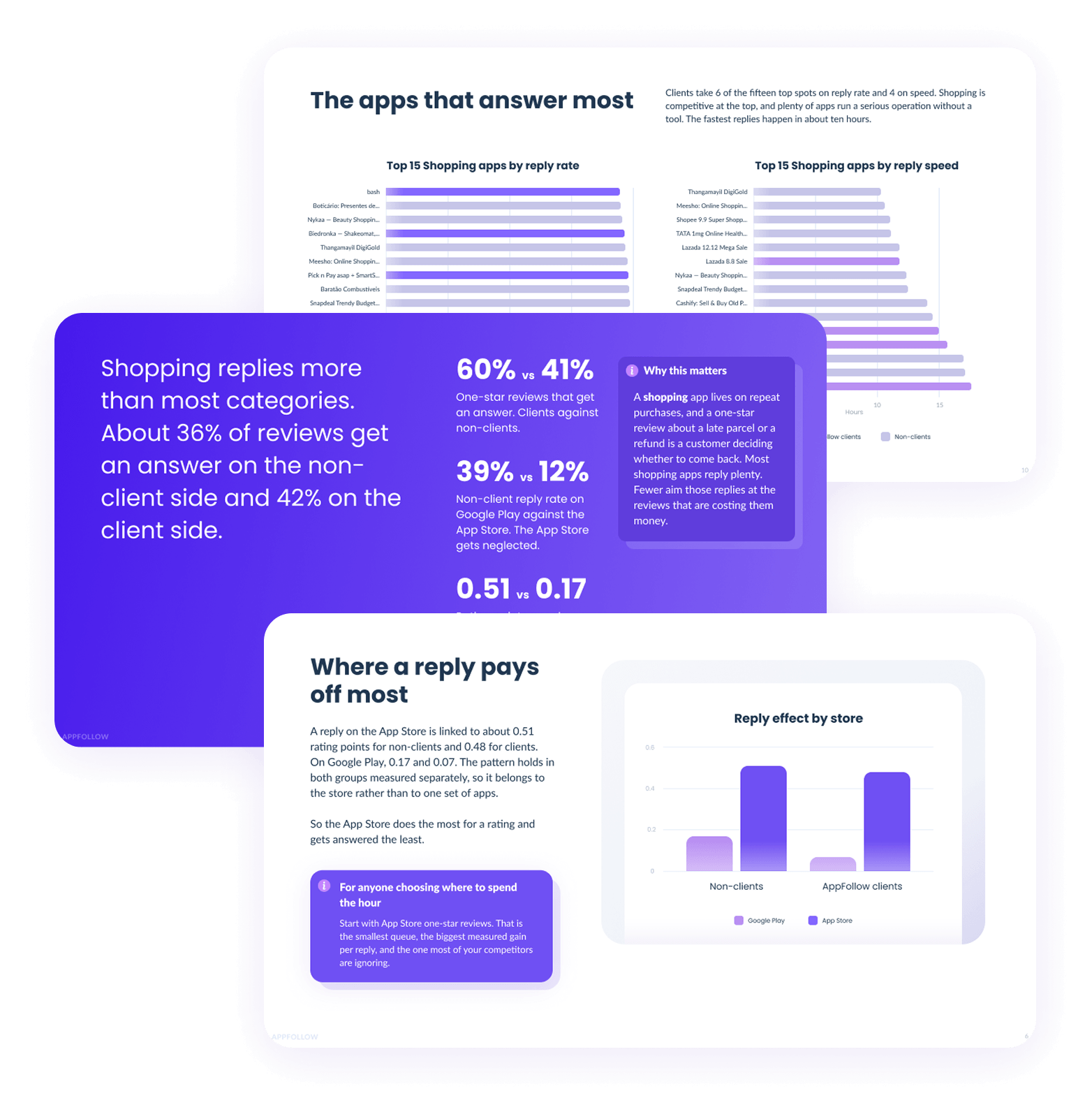
60% vs 41%
One-star reviews that get an answer. AppFollow clients vs. non-clients
39% vs 12%
Reply rate on Google Play against the App Store, for apps without a structured process
0.51 vs 0.17
Rating points a reply recovers on the App Store against Google Play
48% vs 5%
Share of replies sent through automation
41% vs 33%
Overall reply rate with apps matched by size
10 hours
Fastest average reply time in the category
What you'll find inside
The report charts reply rate by star, reply rate and reply effect by store, reply speed, the rating split, and automation. Google Play and the App Store are shown apart, because in Shopping they behave differently.
Advice is split by team: support gets a rule for sorting the queue and a per-store target; operations gets the automation split, which replies belong on rules and which need a person; product gets a way to read one-star reviews by theme. In Shopping, they divide into delivery, refunds, and item quality, and only the first of those three usually belongs to support.
There is also a size-matched comparison for anyone who suspects the difference is really about company size, and an honest section on the two metrics where the client group comes out behind.
Key takeaway
Shopping replies in volume. The problem is aim: non-clients answer about the same share of reviews whatever the rating says, roughly 41% at one star and 35% at five. Clients answer 60% at one star and 34% at five.
The App Store sharpens it. That is where a reply is worth about half a rating point, and it is the store most apps answer least.
FAQ
What is app reputation management?
It is the practice of monitoring and responding to how users see your app. That means tracking ratings, reviews, and sentiment across the app stores, and increasingly in the other places users talk about your product.
Shopping already replies a lot. What is the problem?
Aim. Apps without a structured process answer 41% of one-star reviews and 35% of five-star ones, so the queue gets worked top to bottom. A customer whose order never arrived gets about the same attention as someone who wrote two nice words.
Why does the App Store matter so much in this category?
A reply there is linked to about 0.51 rating points, against 0.17 on Google Play, and the pattern holds in both groups measured separately. Shopping apps answer 12% of their App Store reviews against 39% on Google Play, so the biggest payoff waits in the queue with the least attention.
Which metrics should a shopping team track?
Reply rate, one-star reply rate, and reply rate per store. A healthy combined figure can hide an App Store queue that nobody has touched in months.
How do teams keep coverage even across both stores?
Automation. Client apps send 48% of replies through automated workflows against 5% for non-clients. The report spells out which replies belong on rules and which need a person.
Are AppFollow clients ahead on every metric?
No. Their replies are slower, 171 hours against 99, and their overall reply effect is slightly lower. The report states both. The claim it makes is about aim.
